Poker and the Sunk Cost Effect: Don't Throw Good Money After Bad
Understanding how the sunk cost fallacy destroys poker profits. Learn to recognize and overcome this cognitive bias to make better decisions at the tables.
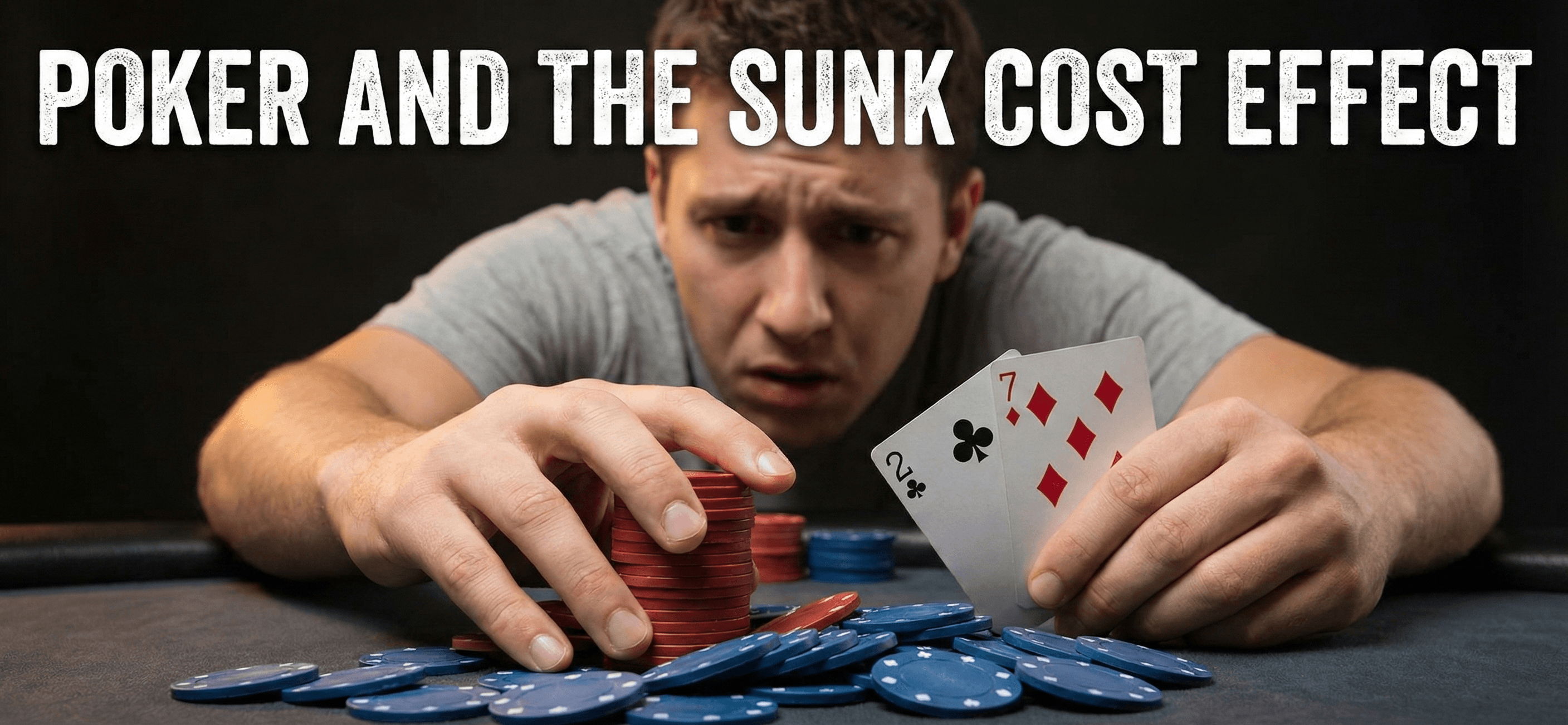
Poker and the Sunk Cost Effect: Don't Throw Good Money After Bad
The sunk cost fallacy is one of the most expensive cognitive biases in poker. It causes players to make irrational decisions based on past investments rather than future expectations, leading to massive leaks in their game. Understanding and overcoming this psychological trap is essential for any serious poker player looking to maximize their edge and profitability.
What is the Sunk Cost Effect?
Defining the Fallacy
The sunk cost fallacy is the tendency to continue investing in something because you've already invested resources (money, time, effort) into it, regardless of whether continuing makes rational sense.
Key principle: Past investments should not influence current decisions. Only future expected value matters.
The Sunk Cost Effect in Everyday Life
Before diving into poker applications, consider common examples:
| Scenario | Sunk Cost | Irrational Decision | Rational Decision |
|---|---|---|---|
| Movie ticket | $15 for boring movie | Stay to "get your money's worth" | Leave and do something enjoyable |
| Failed business | $50K invested | Continue losing money | Cut losses, move on |
| Bad relationship | Years invested | Stay due to time spent | Leave if unhappy |
| Broken car | $3K in repairs | Keep fixing older issues | Sell/trade for reliable car |
In each case, the money/time already spent is gone. The rational choice considers only future costs and benefits.
The Sunk Cost Effect in Poker
Hand-Level Examples
The sunk cost fallacy appears in multiple forms during poker hands:
Example 1: The Preflop Investment
Situation:
- You raise preflop with A♠K♠ to $15 (Sunk cost: $15)
- Three callers ($60 pot)
- Flop: 8♥ 7♦ 2♣ (rainbow, no help)
- You continuation bet $40 (Sunk cost: $55)
- One caller ($140 pot)
- Turn: 6♥ (still no help)
Sunk Cost Thinking: "I've already invested $55 into this pot. I can't fold now or I'll lose all that money."
Rational Thinking: "My $55 is already in the pot—it's no longer mine. The question is: should I invest MORE money given my hand strength and opponent's likely holdings?"
Mathematical Analysis:
Let's calculate if a turn bet makes sense:
| Factor | Value |
|---|---|
| Pot size | $140 |
| Your proposed bet | $80 |
| New pot total | $220 |
| Your additional investment | $80 |
| Pot odds if called | 2.75:1 |
| Estimated equity vs. range | ~25% |
| Required equity | 26.7% |
| Expected Value | Negative |
Calculation:
- EV of betting: (0.25 × $220) - (0.75 × $80) = $55 - $60 = -$5
- EV of folding: $0
- Correct decision: Fold
Your previous $55 investment is irrelevant to this decision. Betting more is throwing good money after bad.
Example 2: The Tournament Sunk Cost
Situation:
- $1,000 tournament buy-in
- 3 hours played
- Current stack: 8 big blinds
- Dealt 7♦ 6♦ on the button
- Under-the-gun player raises 3x
Sunk Cost Thinking: "I've invested $1,000 and 3 hours. I need to take a chance to stay alive."
Rational Thinking: "My buy-in and time are sunk costs. The question is: does calling or folding this specific hand maximize my tournament equity?"
ICM Calculation Example:
| Action | Estimated Tournament Equity |
|---|---|
| Fold 76s | $420 |
| Call with 76s | $380 |
| Optimal play | Fold |
The $1,000 buy-in is already spent. Making a -EV call doesn't "protect" that investment—it reduces your remaining equity further.
Session-Level Sunk Cost Fallacy
The "Get Even" Trap
One of the most destructive manifestations of sunk cost thinking in poker is the compulsion to "get even" during a losing session.
Common Scenario:
| Time | P/L | Player State | Typical Reaction |
|---|---|---|---|
| Hour 1 | -$500 | Frustrated | "Bad variance, stay calm" |
| Hour 2 | -$1,200 | Angry | "Need to win this back" |
| Hour 3 | -$2,000 | Desperate | "Can't quit now, too deep" |
| Hour 4 | -$3,500 | Tilting | "All-in with marginal hands" |
The Fallacy: "I'm already down $2,000. I need to keep playing to win it back."
The Reality: Your losses are already incurred. Continuing to play while tilted and making poor decisions only increases expected losses.
Mathematical Truth:
Your expected value for future hands is independent of your current session P/L:
- If your hourly win rate is $50/hour at your A-game
- But you're tilting and playing at -$100/hour
- Every additional hour costs you $100 in expectation
- Your past losses are irrelevant to whether you should continue
Game Selection and Sunk Costs
The "Time Investment" Fallacy
Scenario: You wait 2 hours for a specific seat in a juicy game. After 30 minutes, several good players sit down and weak players leave.
Sunk Cost Thinking: "I waited 2 hours for this seat. I should play at least another few hours to make the wait worthwhile."
Rational Thinking: "The 2 hours I waited are sunk. The current game is no longer profitable. I should find a better game immediately."
Expected Value Comparison:
| Action | EV/Hour | 3-Hour Session Value |
|---|---|---|
| Stay in mediocre game | $10/hr | $30 |
| Find better game | $40/hr | $120 |
| Difference | $30/hr | $90 |
The 2-hour wait cost you opportunity, but staying compounds that loss.
The Psychology Behind Sunk Cost Thinking
Why Our Brains Fall for This Trap
Several psychological mechanisms drive sunk cost fallacy:
1. Loss Aversion
Humans feel losses approximately 2-2.5x more intensely than equivalent gains. Once we've invested money, admitting it's lost feels painful.
Example in Poker:
- Losing $200 feels worse than winning $200 feels good
- This causes us to take irrational risks to avoid "realizing" the loss
- Folding a pot makes the loss "real," so we're biased toward continuing
2. Commitment and Consistency
We want to appear consistent in our decisions. Changing course feels like admitting we were wrong initially.
Example in Poker:
- "I raised preflop, so I should follow through"
- "I called the flop, so I should continue on the turn"
- This creates escalating commitment to bad lines
3. Waste Aversion
We're emotionally driven to avoid "wasting" our investments, even when continuing wastes more.
Example in Poker:
- "I can't fold, I've already put too much in the pot"
- This leads to calling down with weak hands
- The result: losing even more money
Measuring the Cost of Sunk Cost Fallacy
Research-Based Impact:
Studies in poker decision-making show:
- Players call 23% more often after making large preflop investments
- Tournament players take 31% more risks with short stacks vs. fresh buy-ins
- Session-based sunk cost thinking costs average players 2-3bb/100 hands
Annual Cost Example:
For a player playing 100,000 hands at $2/$5:
- Sunk cost leak: 2.5bb/100
- Cost per 100 hands: $12.50
- Annual cost: $12,500
That's a massive leak from a single cognitive bias!
Recognizing Sunk Cost Fallacy in Your Game
Warning Signs Checklist
Watch for these red flags indicating sunk cost thinking:
In-Hand Indicators:
- Thinking "I'm pot-committed" without calculating odds
- Feeling you "must" continue because you raised preflop
- Calling because you "already invested too much to fold"
- Defending your initial decision rather than reassessing
- Calculating pot odds incorrectly by including your own money
Session-Level Indicators:
- Setting "get even" goals during a session
- Feeling you can't quit while losing
- Making larger bets to "win it back faster"
- Moving up stakes during a downswing
- Playing longer than planned to recoup losses
Long-Term Indicators:
- Staying in unprofitable games due to time investment
- Continuing to play a format you're no longer beating
- Refusing to quit poker despite consistent losses
- Chasing losses across multiple sessions
Self-Assessment Exercise
Review your last 10 losing sessions and honestly answer:
| Question | Yes | No |
|---|---|---|
| Did I play longer than planned? | ||
| Did I move up in stakes? | ||
| Did I make calls thinking "pot-committed"? | ||
| Did I refuse to quit while stuck? | ||
| Did I play weaker hands to "gamble"? |
If you answered "Yes" to 2+ questions, sunk cost fallacy is likely costing you money.
Overcoming the Sunk Cost Fallacy
Mental Framework: Only Future Matters
Train yourself to think exclusively about future expectations:
The Three-Question Method:
For every decision, ask:
- "What is my expected value for future action X?"
- "What is my expected value for future action Y?"
- "Which action has higher EV?"
Notice what's NOT in these questions: any reference to past investments.
Practical Techniques
Technique 1: The Clean Slate Visualization
Practice: Before each decision, visualize this scenario:
- Imagine you just sat down with zero investment
- The pot contains $X (including your previous bets)
- Your cards are [your actual cards]
- Action is on you
Question: "If I were just sitting down right now, what would I do?"
This removes emotional attachment to past investments.
Technique 2: Pot Commitment Calculation
Many players misuse "pot commitment." Calculate it correctly:
Formula: You're pot-committed when:
- (Pot × Your Equity) > (Cost to Call)
Example:
| Component | Value |
|---|---|
| Pot (including villain bet) | $500 |
| Your equity vs. villain range | 30% |
| Cost to call | $100 |
Calculation:
- $500 × 0.30 = $150
- $150 > $100
- You ARE pot-committed
But here's the key: Your previous investments are already in the pot. They don't matter. What matters is whether future investment is profitable.
Technique 3: The Stop-Loss Protocol
Session Management: Implement mechanical stop-loss rules that override sunk cost emotions:
-
Before each session, define:
- Maximum buy-ins you'll invest (e.g., 3 buy-ins)
- Time limit for session (e.g., 4 hours)
- Tilt indicators that trigger auto-quit
-
During session:
- Track losses objectively
- Set phone alarms for time checks
- Use physical reminders (chip in pocket)
-
When limits hit:
- Automatic quit—no exceptions
- NO "just one more orbit" thinking
- Consider past losses as tuition, not motivation
Expected Value of Stop-Loss:
| Scenario | No Stop-Loss | With Stop-Loss | Difference |
|---|---|---|---|
| 3-BI downswing session | -$1,200 + 2hr tilt (-$400) | -$1,200 (quit) | +$400 |
| Monthly (4 occurrences) | -$6,400 | -$4,800 | +$1,600 |
Stop-losses protect you from sunk cost spirals.
Technique 4: EV Journaling
Daily Practice: After each session, journal three hands where you suspect sunk cost thinking:
Template:
- Describe situation and what you were thinking
- Identify the sunk cost (money, time, chips already invested)
- Calculate actual EV of your action
- Determine rational decision
- Note emotional state that drove the error
Example Entry:
Hand: Called $200 turn bet with weak pair after investing $150 preflop and flop.
Sunk Cost: $150 previous investment
Thinking: "Already put in $150, can't fold now"
Actual EV: -$45 (pot odds required 33% equity, had ~20%)
Rational Decision: Fold
Emotional State: Frustrated from previous hands, didn't want to "give up"
This builds awareness and gradually retrains your decision-making process.
Advanced: Implementing a Decision Tree Framework
Create a standardized decision tree that bypasses emotional reasoning:
Decision Tree Structure:
Decision Point
    ├─ Calculate pot odds required
    ├─ Estimate equity vs. opponent range
    ├─ Compare equity to pot odds
    ├─ Consider implied odds (if relevant)
    └─ Make EV-maximizing decision
Critical Rule: Past investments are NOT factors in this tree.
Understanding proper decision-making under pressure connects to our discussion of stress and decision-making in high-stakes poker.
The Relationship to Other Cognitive Biases
Sunk Cost vs. Other Poker Fallacies
The sunk cost fallacy often works in combination with other biases:
| Bias | How It Interacts with Sunk Cost | Combined Impact |
|---|---|---|
| Texas Sharpshooter | Selectively remembering times calling "worked" | Reinforces bad calling habits |
| Gambler's Fallacy | "Due for a win" after losses | Increases desperation plays |
| Confirmation Bias | Seeking evidence that continuing is right | Ignores warning signs |
| Availability Heuristic | Remembering recent success stories | Overestimates comeback probability |
Breaking the Bias Chain
To effectively eliminate sunk cost thinking, you must address these related biases through:
- Comprehensive hand review using tracking software
- Regular consultation with coaches or study groups
- Mathematical rigor in analyzing your play
- Emotional awareness and mindfulness practices
Real-World Examples from Professional Poker
Tournament Example: The 12-Hour Grind
Scenario: Professional player in Day 2 of major tournament:
- Invested: $10,000 buy-in + 12 hours play time
- Current stack: 15 big blinds (below average)
- Facing all-in from chip leader
Amateur Thinking: "I've been here 12 hours and paid $10K. I have to call and give myself a chance."
Professional Thinking: "My time and buy-in are sunk. This specific call is +EV or -EV independent of those factors. Let me calculate ICM and equity."
The Result: Professional folds despite time investment, maximizing tournament equity. Amateur calls with -EV, likely busting.
Cash Game Example: The Stuck Professional
Professional players also struggle with sunk cost fallacy. The difference is awareness and systems:
Losing Day Strategy:
- Take scheduled break every 90 minutes
- Evaluate game quality objectively
- Compare current EV/hour to alternatives
- Ignore current P/L when deciding to continue
- Implement hard stop-loss (e.g., "quit if 5+ buy-ins down")
External Resources
Deepen your understanding of cognitive biases and decision-making:
- Behavioral Economics Guide - Comprehensive research on sunk cost fallacy
- Thinking, Fast and Slow - Daniel Kahneman - Foundational work on cognitive biases (available at most libraries)
- PubMed Psychology Research - Academic studies on decision-making biases
Practical Implementation Plan
30-Day Sunk Cost Elimination Challenge
Week 1: Awareness
- Journal every decision where you considered past investment
- Review 10 previous sessions for sunk cost errors
- Study poker math and probability
Week 2: Mental Training
- Practice "clean slate" visualization before every decision
- Calculate actual pot odds and equity
- Implement session stop-loss rules
Week 3: Mechanical Implementation
- Use decision trees for standard situations
- Set alarms/timers for tilt checks
- Review every session with focus on sunk cost spots
Week 4: Refinement
- Analyze improvement in decision quality
- Identify remaining sunk cost patterns
- Adjust systems based on results
Measuring Progress
Track these metrics monthly:
| Metric | Baseline | Target Improvement |
|---|---|---|
| Average session length when losing | ___ hours | -20% |
| Calls after large preflop investment | ___% | -30% |
| Times quitting while stuck | ___/10 | +50% |
| Overall bb/100 win rate | ___ | +2-3bb |
Conclusion
The sunk cost fallacy is one of poker's most expensive cognitive biases, quietly draining profits from even experienced players. Past investments—whether money, time, or emotional energy—are gone. They should have zero influence on your current decisions.
Every poker decision should be made with a simple question: "What action maximizes my expected value going forward?" Your previous bets, session results, tournament buy-ins, and time investments are all irrelevant to this question.
By recognizing sunk cost thinking, implementing mental frameworks that focus exclusively on future EV, and establishing mechanical systems to override emotional reasoning, you can eliminate this leak and significantly improve your results.
Remember: The money you've already put into a pot isn't yours anymore. Trying to "protect" it by throwing good money after bad is the classic sunk cost trap. Master this principle, and you'll have a massive edge over opponents who haven't.
Understanding concepts like expected value and pot odds provides the mathematical foundation for rational decision-making, while mastering the psychological aspects discussed here ensures you apply that knowledge correctly under pressure.
Don't fall for sunk costs. Make decisions based on future expectation, not past investment. Your bankroll will thank you.
⚠️ Responsible Gambling Reminder
While understanding poker strategy and mathematics can improve your game, always gamble responsibly. Set limits, take breaks, and remember that poker involves both skill and chance. For support, visit www.problemgambling.ie.
Related Articles

Poker and Psychology: Master the Mind Game Behind Every Hand
Explore the psychological foundations of poker success. Learn cognitive biases, emotional control, game theory psychology, and mental frameworks for optimal decision-making.

Analyzing Your Play: Essential Techniques for Poker Improvement
Master the art of self-analysis in poker. Learn systematic review methods, hand history analysis, leak identification, and data-driven approaches to elevate your game.
The Texas Sharpshooter Fallacy: How Poker Players Fool Themselves with False Patterns
Understand the Texas Sharpshooter Fallacy and its impact on poker decision-making. Learn to distinguish genuine patterns from random clustering and avoid costly cognitive biases.