A Poker Winner's Checklist: Discipline, Focus, and Planning for Success
Master the essential poker winner's checklist covering discipline, mental focus, strategic planning, and integrating all elements for consistent success at the tables.
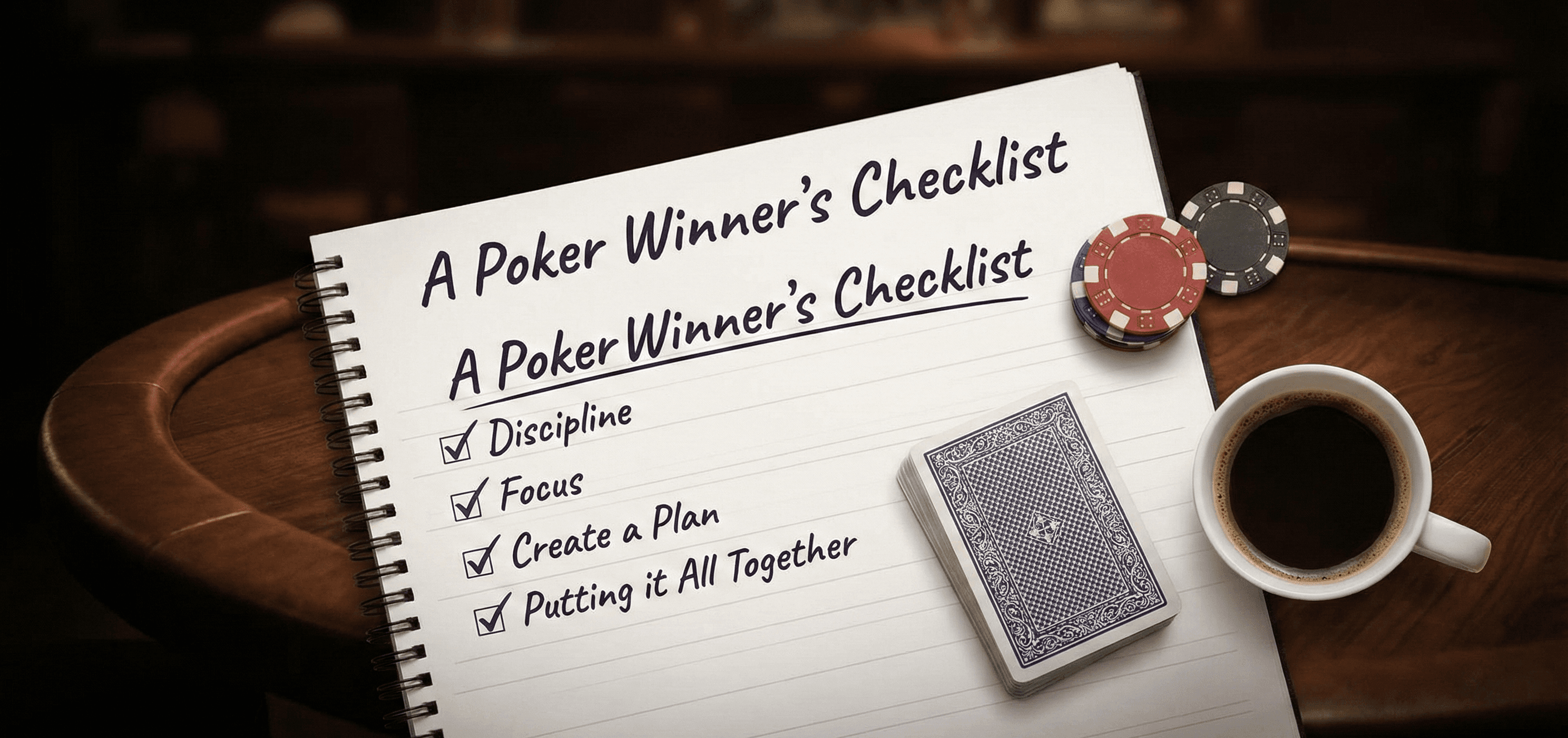
A Poker Winner's Checklist: Discipline, Focus, and Planning for Success
Winning at poker consistently requires more than just technical skills and mathematical knowledge. The most successful players follow a systematic approach that encompasses discipline, focus, strategic planning, and the ability to integrate these elements seamlessly. This comprehensive checklist will guide you through the essential components of becoming a winning poker player.
Part 1: Discipline - The Foundation of Winning Poker
Discipline is the cornerstone of long-term poker success. Without it, even the most talented players will struggle to maintain profitability.
Bankroll Discipline
Your bankroll is your lifeline in poker. Managing it properly is non-negotiable for sustained success.
| Poker Format | Recommended Bankroll | Conservative Bankroll | Risk Level |
|---|---|---|---|
| Cash Games (NL) | 20-30 buy-ins | 40-50 buy-ins | Medium |
| Tournaments (MTTs) | 50-100 buy-ins | 100-200 buy-ins | High |
| Sit & Go's | 30-50 buy-ins | 75-100 buy-ins | Medium-High |
| Mixed Games | 40-60 buy-ins | 80-100 buy-ins | Variable |
Example Bankroll Calculation:
If you're playing $1/$2 NL cash games with a $200 buy-in:
- Minimum bankroll: $200 × 20 = $4,000
- Conservative bankroll: $200 × 40 = $8,000
This ensures you can withstand natural variance without going broke.
Game Selection Discipline
Not all games are created equal. Winners consistently choose profitable games over their ego.
Checklist for Game Selection:
- ✅ Are there at least 2-3 weaker players at the table?
- ✅ Is your win rate consistently positive in this game?
- ✅ Can you maintain focus for the expected session length?
- ✅ Is the game within your bankroll requirements?
- ✅ Are you mentally prepared for this session?
Emotional Discipline
One of the most challenging aspects of discipline is maintaining emotional control, especially during downswings.
Stop-Loss Limits: Create predetermined stop-loss limits for your sessions:
- Cash games: 2-3 buy-ins per session
- Tournaments: Set a daily/weekly buy-in limit
- Mental fatigue: Quit when concentration drops
Part 2: Focus - Maintaining Your Mental Edge
Focus is what separates good decisions from great ones. In poker's information-rich environment, maintaining concentration is crucial.
Pre-Session Focus Preparation
Your session begins before you sit at the table. Implement a pre-game routine:
30 Minutes Before Playing:
- Review recent hand histories (15 minutes)
- Set session goals and expectations (5 minutes)
- Physical preparation: hydration, nutrition (5 minutes)
- Mental warm-up: breathing exercises (5 minutes)
Eliminating Distractions
Modern poker, especially online, presents countless distractions. Create an optimal environment:
| Distraction Type | Solution | Impact on Win Rate |
|---|---|---|
| Social Media | Block apps during sessions | +5-10% |
| Multiple Tables | Reduce table count | +8-15% |
| Poor Environment | Dedicated playing space | +3-7% |
| Fatigue | Scheduled breaks | +10-20% |
Focus Maintenance Techniques
The Pomodoro Method for Poker:
- Play focused: 45-minute sessions
- Break: 5-10 minutes away from tables
- Review: Quick hand analysis
- Repeat: Maximum 4-5 cycles per day
Mathematical Focus Example:
Research shows focus deteriorates over time. If your A-game win rate is 5bb/100:
- Hour 1-2: 5bb/100 (peak performance)
- Hour 3-4: 3bb/100 (declining focus)
- Hour 5+: 0-1bb/100 (or negative)
Calculation: Playing 6 hours straight vs. 4 hours focused:
- 6-hour session: (200 hands × 2 hours × 5bb) + (200 hands × 2 hours × 3bb) + (200 hands × 2 hours × 0bb) = 3,200bb
- 4-hour session: (200 hands × 4 hours × 5bb) = 4,000bb
The shorter, focused session yields 25% more profit per hour!
Recognizing Focus Breakdown
Watch for these warning signs:
- Making obvious mistakes you normally wouldn't
- Feeling bored or impatient
- Checking phone frequently
- Not remembering recent hands clearly
- Wanting to "get even" quickly
Learn more about maintaining focus under pressure in our guide on stress and decision-making in high-stakes poker.
Part 3: Create a Plan - Strategic Framework
Winners don't just show up and play. They have detailed, adaptable plans for every session.
Pre-Game Strategic Planning
Session Goals Checklist:
- Define specific goals (not just "win money")
- Identify target opponents and their tendencies
- Review recent leak analysis
- Plan table selection criteria
- Set time and buy-in limits
Developing Your Game Plan
Table-Specific Adjustments:
| Player Type | Your Adjustment | Expected ROI Increase |
|---|---|---|
| Tight-Passive | Increase bluff frequency | +3-5bb/100 |
| Loose-Aggressive | Tighten range, let them bluff | +5-8bb/100 |
| Calling Station | Value bet thinner, reduce bluffs | +4-6bb/100 |
| Nit | Steal blinds aggressively | +2-4bb/100 |
Study Plan Integration
Create a structured study routine that complements your playing schedule:
Weekly Study Structure:
- Monday: Hand history review (2 hours)
- Tuesday: Video training content (1 hour)
- Wednesday: Solver work on common spots (1.5 hours)
- Thursday: Peer discussion/coaching (1 hour)
- Friday: Pre-weekend preparation (30 minutes)
- Weekend: Play sessions with notes
- Sunday: Weekly review and adjustment
Mathematical Planning Example
ROI Analysis for Tournament Players:
If you play 20 tournaments per week at $50 each with a 15% ROI:
- Weekly investment: 20 × $50 = $1,000
- Expected return: $1,000 × 1.15 = $1,150
- Weekly profit: $150
- Monthly profit: $600
- Annual profit: $7,200
But with improved game theory understanding raising your ROI to 20%:
- Annual profit increases to $10,400 (+44%)
Adaptive Planning
Your plan must be flexible. Review and adjust based on:
- Weekly performance metrics
- Changing player pools
- Personal life circumstances
- Emerging strategies and trends
Use the insights from analyzing your play to continuously refine your approach.
Part 4: Putting It All Together - Integration and Execution
The real magic happens when discipline, focus, and planning work in harmony.
The Winner's Pre-Session Ritual
Complete Checklist (15 minutes):
-
Physical Preparation (5 minutes)
- Proper hydration
- Healthy meal/snack
- Comfortable temperature
- Good posture and ergonomics
-
Mental Preparation (5 minutes)
- Review session goals
- Set stop-loss and time limits
- Visualization of quality play
- Breathing exercises
-
Technical Preparation (5 minutes)
- Software/tools functioning
- Notes on opponents accessible
- Tracking software running
- Distractions minimized
During-Session Integration
Continuous Monitoring System:
Create checkpoints every 30-60 minutes:
- Discipline Check: Am I playing within my bankroll? Following my game plan?
- Focus Check: Is my concentration sharp? Should I take a break?
- Plan Check: Am I adjusting to table dynamics? Sticking to strategic goals?
Integration Matrix:
| Time | Discipline Action | Focus Action | Planning Action |
|---|---|---|---|
| Pre-session | Verify bankroll | Prepare environment | Review strategy |
| Hour 1 | Monitor buy-ins | Peak concentration | Execute plan |
| Hour 2 | Check profit/loss | Maintain focus | Adjust tactics |
| Hour 3 | Evaluate stops | Take break | Reassess opponents |
| Hour 4 | Consider ending | Focus techniques | Strategic pivots |
| Post-session | Log results | Note focus issues | Update game plan |
Post-Session Review
Winners maximize learning from every session:
The 4-Step Review Process:
-
Results Analysis (10 minutes)
- Record win/loss and buy-ins
- Note significant hands
- Calculate actual vs. expected results
-
Discipline Audit (5 minutes)
- Did I follow bankroll rules?
- Were there emotional decisions?
- Did I quit at appropriate times?
-
Focus Evaluation (5 minutes)
- When did concentration peak/drop?
- What caused distractions?
- How long was optimal session length?
-
Strategic Assessment (10 minutes)
- Were adjustments effective?
- What worked/didn't work?
- Key learnings for next session
Building Long-Term Success Habits
Monthly Review Checklist:
- Analyze overall win rate trends
- Identify biggest leaks and progress
- Review bankroll growth/requirements
- Assess goal achievement
- Update strategic approach
- Plan study focus for next month
Quarterly Deep Dive:
- Comprehensive database analysis
- Major strategic adjustments
- Bankroll level changes
- Game selection reassessment
- Consider coaching/training investments
The Compound Effect in Poker
Small improvements compound dramatically over time:
Example Calculation:
Starting win rate: 3bb/100 hands Improvement through disciplined practice: +0.5bb/100 per quarter
| Quarter | Win Rate | Annual Earnings (100k hands) | Increase |
|---|---|---|---|
| Q1 | 3.0bb/100 | $3,000 | Base |
| Q2 | 3.5bb/100 | $3,500 | +17% |
| Q3 | 4.0bb/100 | $4,000 | +33% |
| Q4 | 4.5bb/100 | $4,500 | +50% |
This 50% increase comes purely from consistent application of the winner's checklist!
Creating Your Personal Checklist
Customize this framework to your game:
Download and Adapt:
- Start with the core elements (discipline, focus, planning)
- Add game-specific items relevant to your format
- Include personal triggers and warning signs
- Review and update monthly
- Share with accountability partners
For guidance on progressing through stakes, read our article on when to move up in stakes.
External Resources
To further develop your winner's mindset, explore these valuable resources:
- PokerNews Strategy Section - Comprehensive strategy articles and professional insights
- Two Plus Two Forums - Community discussion on poker psychology and strategy
- Poker Psychology Resources - American Psychological Association - Research on decision-making and performance psychology
Conclusion
The poker winner's checklist isn't just a list—it's a lifestyle. By integrating discipline, focus, and strategic planning into every aspect of your game, you create a sustainable framework for long-term success.
Remember: champions aren't made at the tables alone. They're crafted through consistent application of winning principles, day after day, session after session. Start implementing this checklist today, and watch your results transform over time.
Understanding concepts like pot odds and expected value will enhance your strategic planning, while mastering the psychological aspects will keep you performing at your peak.
The question isn't whether you can win—it's whether you'll follow the checklist that makes winning inevitable.
⚠️ Responsible Gambling Reminder
While understanding poker strategy and mathematics can improve your game, always gamble responsibly. Set limits, take breaks, and remember that poker involves both skill and chance. For support, visit www.problemgambling.ie.
Related Articles

Poker and Psychology: Master the Mind Game Behind Every Hand
Explore the psychological foundations of poker success. Learn cognitive biases, emotional control, game theory psychology, and mental frameworks for optimal decision-making.

Analyzing Your Play: Essential Techniques for Poker Improvement
Master the art of self-analysis in poker. Learn systematic review methods, hand history analysis, leak identification, and data-driven approaches to elevate your game.

Dealing with Downswings in Poker: Mental Strategies for Variance
Learn how to handle poker downswings with proven psychological strategies. Master bankroll management, emotional control, and mental resilience during losing streaks.